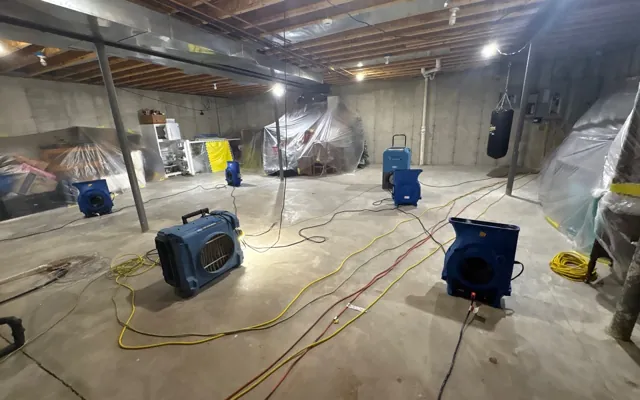
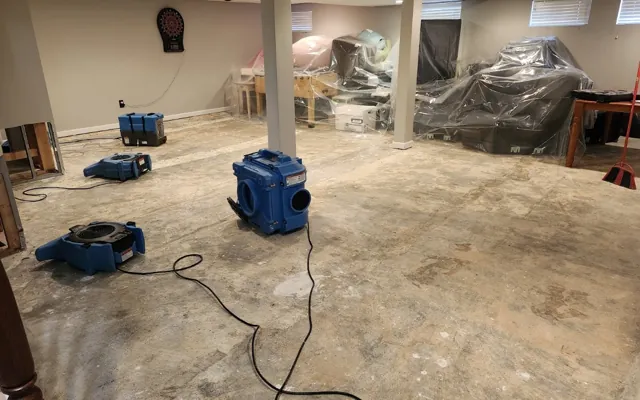
When a basement floods in Fletcher Hills, CA, local crews respond fast. They follow IICRC-standard methods to extract water, dry the structure, and document everything for insurance, helping residents get back on solid ground.

For Fletcher Hills calls, a crew is typically on site within about an hour. They first work to stop the water source, whether from a hillside storm or a broken water heater, and check for safety before starting cleanup.
Technicians use pumps to clear standing water from the concrete slab. Soaked drywall, baseboards, or flooring that cannot be dried in place are removed to prevent mold from being sealed inside the walls of the hillside home.
Industrial air movers and dehumidifiers are set to dry the slab and framing. Daily moisture readings are logged to verify the home is dry, creating a clear record for the homeowner's insurance file.

Ground-floor flood cleanup in Fletcher Hills typically runs from about $1,200 to $5,500 depending on how many rooms are affected, whether drywall and flooring have to come out, and how long the water sat before it was found. A garage or single-room slab flood from a quick supply line failure sits on the lower end; a multi-room loss after a valley storm with saturated drywall sits higher. Most of this work is documented with moisture readings and photos for direct submission to the homeowner's insurance carrier.
Fletcher Hills is built on slopes, with many ranch homes from the 1940s to 1960s set into hillside lots. This terrain naturally directs storm runoff and groundwater toward foundations, making slab leaks, broken water heaters, and resulting basement floods a common call for restoration crews in this El Cajon neighborhood. The hillside lots in Fletcher Hills, CA, channel water directly toward home foundations. Combined with aging plumbing systems common in mid-century ranch homes, this creates a regular need for basement flood cleanup after slab leaks or appliance failures. From Fletcher Hills, crews also cover nearby Casa de Oro-Mount Helix, Granite Hills, Santee, La Mesa, Spring Valley, Winter Gardens. See every neighborhood and town on the full service area page.
See all areas servedEvery loss is photographed, measured, and logged from the first visit, so the paperwork holds up with the insurance carrier.
Technicians follow recognized IICRC drying standards and prove it with daily moisture readings on Fletcher Hills homes, not guesswork.
Emergency dispatch any hour of the day or night, with a real crew on the way across the valley, not a callback in the morning.
A real crew dispatched any hour, not a callback in the morning.
Trained technicians following recognized IICRC drying standards.
Truck-mounted, portable, and submersible for any size loss.
The loss is documented and billed to the carrier directly.
Costs depend on the scale. A single room flood from a quick leak might range from about $1,200, while a multi-room loss after a storm, requiring more drywall removal, can be higher. Local crews provide documentation to help with insurance claims.
Drying a concrete slab in a Fletcher Hills home typically takes several days. The crew uses air movers and dehumidifiers, taking daily moisture readings until the structure meets the drying standard. Hillside soil moisture can sometimes extend the timeline slightly.
Crews are on call 24 hours a day and can be on the way to Fletcher Hills within the hour.
Call (619) 350-2773